Read a preview
Chapter 1
Chapter 1: The Hudsons Order Dessert
The server at Ostra had been glancing at the empty chair for forty minutes, and Molly Russell had been pretending not to notice for thirty-nine of them.
"Will your husband still be joining you?" he asked at last, topping off her water with the gentle care of a man handling a wounded bird.
"He's running late," Molly said. "He's always running late. Could you bring the bread anyway? He'll complain if there's no bread."
The server gave her the smile she had seen on servers all over Milwaukee for fourteen months, the one that said he had already decided she'd been stood up and was too polite to say so. She let him think it. It was simpler than the truth.
The truth was lying on the white tablecloth beside her wineglass: a yellow legal pad with a line drawn down the middle. At the top of the left column she had written a C. At the top of the right column, an M.
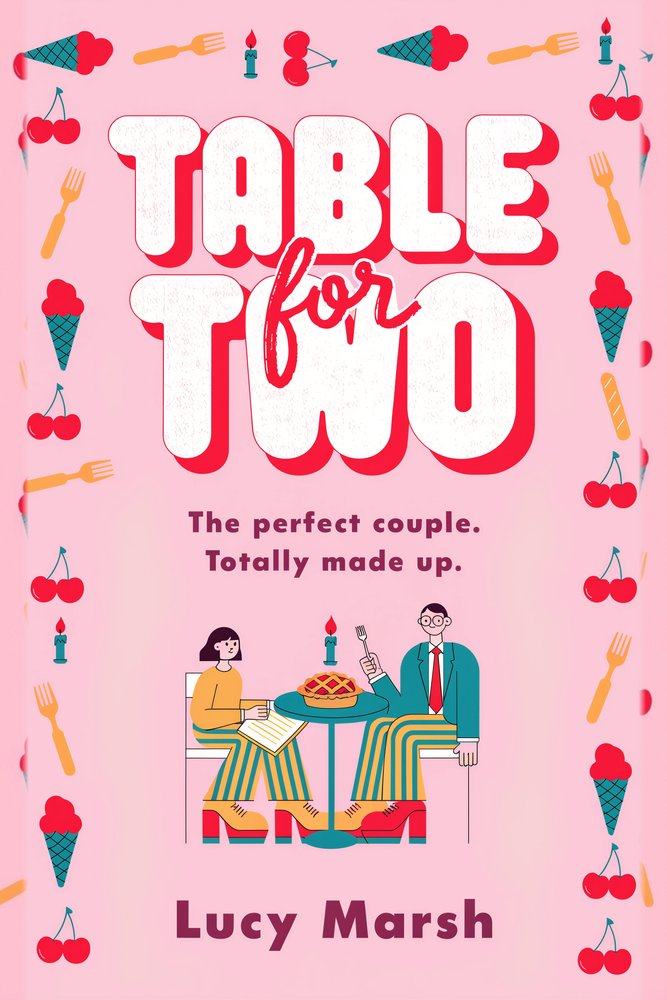
C was Christopher Hudson. M was Mary Hudson. They had been married for forty years, at least in print. Every Thursday in the Milwaukee Courier, under a little drawing of two forks crossed like swords, they went out to dinner and argued about it. Christopher cared about portions, prices, and the bread basket, and he believed most restaurants charged too much for too little. Mary cared about the lighting, the dessert cart, and whether the couple at the next table was holding hands. Readers had planned anniversaries around them. Men had proposed in corner booths because Mary once wrote that a certain booth was made for a question worth asking. A woman in Waukesha had written in to say she and her husband made up after a three-day fight because Christopher admitted, in print, that he had been wrong about the crème brûlée.
Nobody outside the newsroom knew that Christopher and Mary had been invented forty years ago by a pair of copy editors named Albert and Betty Becker. Even fewer people knew that Betty had died fourteen months ago, that Albert had retired the week after her funeral, and that ever since, every word of the column had been written by a twenty-nine-year-old features writer who also handled the obituaries.
Only one person knew that. Her name was Monica Adams. She was the managing editor of the Courier, and she was the reason Molly was sitting alone in a seafood restaurant in the Third Ward on a Tuesday night in early January with her coat draped over the second chair like an understudy.
The bread came in a linen-lined basket. Molly tore off a piece and held it up to the candle. The crust crackled. Inside, the crumb was soft and faintly sour, and the butter beside it had been whipped with honey and a little sea salt. She wrote on the left side of the pad:
*C: Finally, a bread basket that doesn't apologize for itself. I ate three pieces. Mary counted.*
Then, on the right:
*M: He ate four.*
She smiled at her own handwriting, the way she always did, and then felt a little foolish, the way she always did.
This was the job. She ordered for two because the Hudsons always ordered for two. She tasted everything, first as Christopher, chewing slowly and asking whether the price on the menu matched the thing in her mouth, and then as Mary, closing her eyes and asking what the dish was trying to say. She had become very good at it. She could switch voices between bites the way some people switched lanes. She could argue with herself over a sauce for a full paragraph and let both sides win.
The scallops arrived seared to a deep gold, sitting in a pool of brown butter with capers and a scattering of crisp leeks. Molly pulled a pair of drugstore reading glasses from her purse to read the tiny print on the specials card, because every romantic restaurant in America seemed to believe that love required eight-point type and no light. She cut a scallop in half. It was sweet and barely set in the middle, the butter nutty and sharp with lemon.
*C: Fourteen dollars a scallop, if you do the math. I did the math. I would pay it again, which I resent.*
*M: He went quiet after the first bite. Forty years of marriage teaches you that when Christopher goes quiet, the chef has won.*
She had eaten sixty-one dinners like this. Sixty-one tables for two, sixty-one reservations under the name Hudson, sixty-one empty chairs. She had sat in candlelit Italian places on Brady Street and steakhouses downtown with leather booths so deep they swallowed her. She had eaten oysters alone on Valentine's Day in a room full of engagement rings. She had learned which hostesses would seat a single woman by the window and which would hide her by the kitchen door. She had learned to read the couples around her the way Mary would, noticing who leaned in and who checked a phone, who shared dessert and who guarded it.
And every week, she had turned it all into two voices that were not hers.
It wasn't that she didn't love the Hudsons. She did. She had grown up reading them at her father's bar on Lincoln Avenue, the Courier folded open next to the register at Russell's Tavern while the Friday fish fry crowd lined up past the jukebox. Her mother read Mary's lines out loud to her father, and her father pretended he wasn't laughing at Christopher's. When Molly was twelve, she decided she would write about food someday. Not as anybody's invention. As herself. Molly Russell, on top of the page, in small capital letters.
She had come to the Courier at twenty-four to do exactly that, and she had spent five years writing about county fairs, school board fights, and the deaths of strangers. The obituaries had taught her something, at least. People's families always told her about food. Grandpa made the best brats on the block. Mom never measured anything. He drove to Sheboygan for hard rolls every Saturday until his knees gave out. Food was how people remembered each other. She had written that sentence in her head a hundred times and never once in print.
The dessert menu came. Mary always ordered dessert, no matter how full she was, because Mary believed a meal without dessert was a sentence without a period.
"The chocolate pot de crème," Molly said. "With two spoons, please."
The server hesitated just long enough to make her cheeks warm. Then he nodded and brought two spoons.
She used one. She always used one. But she always asked for two, and she had never been able to explain to herself exactly why.
---
It had started in a stairwell.
Fourteen months earlier, the day after Betty Becker's funeral, Monica had found Molly on the landing between the third and fourth floors, eating vending-machine pretzels and editing an obituary for a retired bus driver. Monica was fifty-four, small and sharp, with reading glasses on a beaded chain and a voice that could stop a press run. She sat down on the step beside Molly in her good black skirt, which Molly had never seen her do.
"Albert's done," Monica said. "He told me this morning. He can't go to restaurants without her, and I don't blame him."
"So the column ends?"
"The column is forty years old. Half this city plans its love life around it. If I end it right now, the publisher will use the space for a mattress ad and we'll never get it back." Monica looked at her. "You've edited the Hudsons for Albert. You know their voices."
"I've fixed their commas."
"You've fixed more than commas. I've seen your notes." Monica took one of Molly's pretzels without asking. "A few weeks. Just until we figure something out. Nobody needs to know."
A few weeks had turned into fourteen months. Nobody had figured anything out. And Molly had kept her mouth shut and her legal pad full, because the Hudsons were the closest she had ever gotten to the thing she wanted, even if she had to wear somebody else's names to get there.
---
She paid with the company card, signed the slip *Hudson*, and walked out into a cold that made her eyes water. The wind off the lake came down Broadway like it had somewhere to be. She tucked the legal pad under her arm and walked the six blocks to her car, already rearranging sentences in her head.
The next morning, she was at her desk by eight, typing up Ostra with a cup of bad newsroom coffee, when Monica appeared beside her with a face Molly had only seen on election nights.
"The sale closed," Monica said quietly.
Molly stopped typing. For months there had been rumors. The family that had owned the Courier since before anyone's grandparents were born had finally run out of patience and money. A company called Crestline Media Group had been circling.
"Crestline?"
"Crestline. The new publisher starts Monday. His name is Justin Pierce. He has, and I quote the memo, a passion for audience growth."
"That sounds bad."
"It sounds like slides." Monica lowered her voice even further. "There's more. He's bringing a hire with him. A food critic."
Molly felt her stomach drop the way it did on the Hoan Bridge in high wind. "We have a food critic."
"We have the Hudsons," Monica said. "Which he thinks are two retirees in Shorewood. He's hiring Logan Ellis."
Molly knew the name. Everyone who cared about food in the Midwest knew the name. Logan Ellis had written for the Chicago Standard for seven years, and his reviews were famous for being precise, merciless, and almost always right. He could take apart a forty-dollar entrée in three sentences and make you feel like you'd watched a surgery. Eight months ago, the Standard had softened one of his pans, a brutal review of a steakhouse owned by one of the paper's biggest advertisers, and run the gentler version under his name without asking him. He had quit that same night, in a public post that had been shared a hundred thousand times.
Molly had read that post four times. She had read most of his reviews. She had never admitted that to anybody.
"Why would Logan Ellis come to Milwaukee?" she asked.
Monica took her glasses off and let them drop on their chain. "Because nobody in Chicago will hire a critic who quits in public," she said. "And because Justin Pierce promised him something. I don't know what yet." She tapped Molly's desk twice. "Finish the Hudsons. Make them good this week. Make them very good."
She walked away. Molly looked down at her screen, where Christopher was halfway through a complaint about valet parking, and realized her hands were cold.