
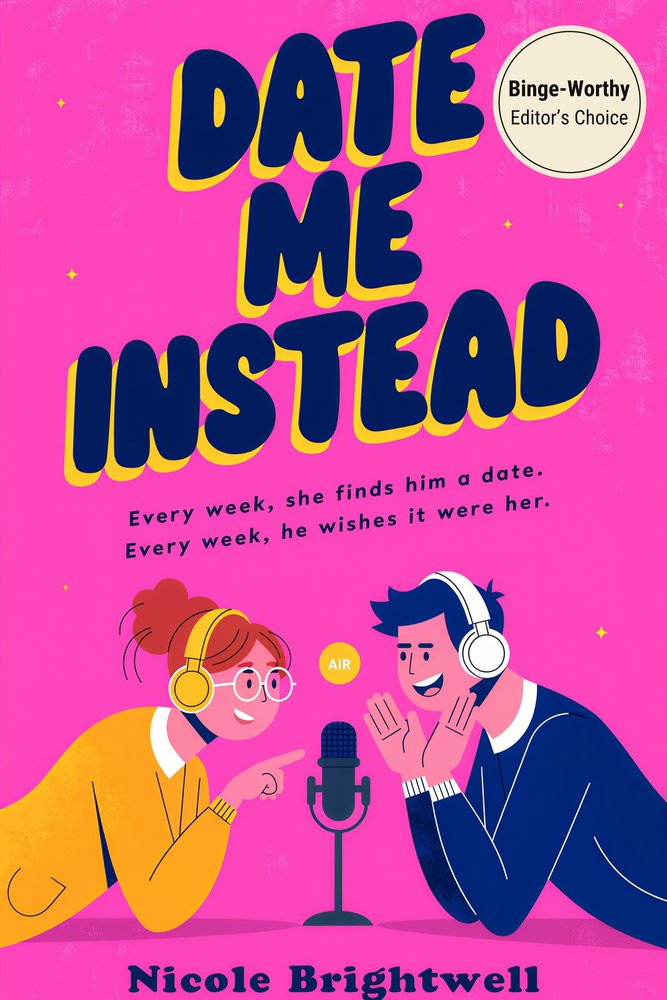
Read a preview
Chapter 1
Chapter 1: Behind the Glass
At one minute to six on a Tuesday morning in October, Lizzie Fletcher had two cups of coffee on her desk, one for drinking and one for holding, and nine years of habit telling her which was which.
The producer's booth at Sheaf 98 was about the size of a generous closet. It held a desk, a phone bank with six blinking lines, two computer screens, a swivel chair whose left armrest had fallen off years ago, and a long window of thick glass that looked into Studio One. On the other side of that glass, Alan Booth was lowering his headphones over his ears the way some men put on a good hat, with a little wiggle at the end to make sure they sat right.
Lizzie pressed the talkback button. "Thirty seconds, Alan."
He raised a thumb without looking up. He had been opening the breakfast show on Sheaf 98 for twenty-six years, and he still read the first link off the screen every morning as if he had never seen it before. Lizzie had written that link at a quarter to five, in the dark kitchen of her apartment in Hillsborough, while the kettle boiled.
The jingle played. Alan leaned into the microphone.
"Morning, Sheffield."
Two words, and the whole city seemed to sit up. Lizzie had heard him say it more than two thousand times, and it still did something to her chest. It was the sound of buses warming up in the depot, of bakers on Abbeydale Road pulling out the first trays, of nurses coming off the night shift at the Northern General and turning up the car radio for the drive home. It was the sound of a place that knew itself.
"It's six o'clock, it's Tuesday, and it's going to rain," Alan said. "I know. I'm as shocked as you are."
Lizzie smiled and pressed the button again. "Travel has a lane closed on the Parkway. Bins phone-in after the half hour. Your guest at seven-forty is the woman with the giant marrow, and she's bringing the marrow."
Alan nodded at the glass, mouthed *bringing the marrow* with deep satisfaction, and went on talking to the city as if Lizzie were not there at all.
That was the job. That had always been the job. She booked the guests and wrote the links. She chased the travel reports and checked the weather. She knew which callers would ramble and which would swear, and she knew which song to play when a guest cried. When something went wrong, and in live radio something always went wrong, she was the calm voice in Alan's ear telling him what to say next. In nine years, she had never once spoken on air. She liked it that way. Or she had told herself she liked it that way for long enough that it felt the same.
At twenty to seven the phone lines lit up for the bins phone-in. Lizzie screened the calls one by one, scribbling names and opinions on a notepad. Steve from Darnall was furious about recycling. Hilary from Crookes wanted to know why the green bin was green when it was mostly brown inside. Line four blinked.
"Sheaf 98, you're through to the breakfast show. What's your name and where are you calling from?"
"Hello, love. It's Mavis. From Gleadless."
Lizzie closed her eyes. "Mum."
"I don't know who that is. I'm Mavis. I've got very strong feelings about the brown bins."
"You live in Totley."
"Gleadless is lovely this time of year."
"Last Thursday you were Joyce from Dore."
There was a short, dignified pause. "Joyce has moved away."
"Thank you for calling, Mavis," Lizzie said, in her most professional voice, and cut the line.
Through the glass, Alan raised his eyebrows. Lizzie mouthed *Mum*, and he laughed silently, his shoulders shaking, while a song about summer played to a city in the rain.
Maureen Fletcher called the show three mornings a week. She had done it for years, under a different name each time, and every time Lizzie recognized her voice in the first two words and politely got rid of her. Lizzie did not quite know why her mother did it. She had never asked. It was one of those things that had become part of the furniture, like the broken armrest and the coffee that tasted faintly of the machine.
The marrow arrived at seven-thirty-five. It was the size of a small child, and its owner, a cheerful woman from Stannington, carried it into the studio wrapped in a tartan blanket. Alan interviewed her as though she had won an Olympic medal. The texts poured in. Lizzie read the best ones out to him through his headphones and he repeated them in his warm, unhurried voice, and for twenty minutes the whole of Sheffield was talking about a vegetable.
This was what Lizzie loved. Not the marrow exactly, but the way a city could turn toward one small, silly, lovely thing and feel like a family for a moment.
---
At nine o'clock, when the show was over and the mid-morning presenter had taken his seat, Ron Pearce put his head around the door of the booth.
"Staff meeting," he said. "Ten minutes. Studio Two."
Ron had owned Sheaf 98 for eighteen years. He was a short, round man who wore cardigans with leather buttons and said things like *We're not the BBC, and thank God for that*. He did not call staff meetings. In nine years Lizzie could remember three, and one of those had been about a mouse.
She found Nisha Patel in the corridor, still holding the printed news bulletin she had read at half past eight.
"Do you know what this is?" Nisha asked.
"No."
"Then it's bad." Nisha tucked a strand of black hair behind her ear. She was the station's newsreader, thirty-one, sharp as a tack, and Lizzie's best friend since the day they had both started on the same Monday and gotten lost looking for the bathroom. "Ron's been on the phone with his door shut since Friday. Ron never shuts his door."
Studio Two was small and smelled of old carpet. Everyone squeezed in: the two producers from the afternoon shows, the sales team, Nisha, Lizzie, and Tim Dodd, the engineer, who had worked at Sheaf 98 for thirty years and who knew every cable in the building by its first name. Alan came in last, still wearing his headphones around his neck.
Ron stood at the front and rubbed his hands together.
"I'll keep it short," he said. "I've sold the station."
The room went very quiet.
"To Clarion Media," Ron went on. "They own twenty-two stations around the country and the big national network out of London. They'll take over at the end of the month. They've promised me they value what we do here. They've promised me that."
He said the last part twice, which Lizzie had learned over the years was what people did when they did not believe something themselves.
Afterward, people drifted out in twos and threes, talking in low voices. Lizzie went back to her booth because she did not know where else to go. On the screen above the door, the station's feed was showing the mid-morning show. On the radio in Ron's office down the hall, she could hear something else: the Clarion national network, playing low.
And a voice she knew.
James Benton had a good voice. It was the first thing anyone noticed about him. It was smooth and friendly and sounded as if he had just heard something wonderful and could not wait to tell you about it. Four years ago, that voice had belonged to the drive-time show on Sheaf 98, and to Lizzie, in the way that people belong to each other when they are twenty-nine and in love and think they will be together forever.
Then Clarion had offered him a weekend show in London. Lizzie had helped him prepare the demo. She had given him her best ideas, the ones she had been saving: a segment where listeners called in to apologize to someone they had wronged, and another where they rang wrong numbers on purpose to make strangers' days better. James had taken them both to London. He had taken them, and he had made them famous, and within a year he had the national breakfast show and his face on the side of buses.
He had asked her to come with him, of course. But he had asked in the way you ask someone to pass the salt, already reaching for it yourself. When she said she needed time to think, he had not waited. Lizzie had stayed behind the glass at Sheaf 98, where she knew how everything worked, and told herself that it was where she was useful.
She reached over and closed Ron's door.
---
On Thursday, two days after the staff meeting, Alan Booth went gray.
It happened just after the eight o'clock news. Nisha had finished reading the headlines, and Alan was back on the mic, introducing a song. Lizzie watched him through the glass the way she always did, and she saw him stop halfway through a sentence and press his hand flat against the left side of his chest.
He finished the link. Of course he did. He was Alan Booth. Then he pushed the fader up on the music, took off his headphones, and looked at her through the window with an expression she had never seen on his face before. He looked frightened.
Lizzie was out of her chair before she had decided to move. She called for Tim as she ran. She dialed the emergency number with one hand while she opened the studio door with the other. Tim took one look and slid into the presenter's seat. He lined up three long songs back to back, the way they had planned for in a fire drill twelve years ago and never once used.
"Sit down, Alan," Lizzie said. "Ambulance is coming. Sit. Don't try to be brave."
"I'm always brave," Alan said, but his voice was thin.
Nisha took the rest of the show. She read the travel and the weather and a long list of listeners' birthdays, and she did not let a single tremble into her voice. Lizzie knelt on the studio floor beside Alan and held his hand until the paramedics came through the door in their green uniforms with their heavy bags.
As they lifted him onto the stretcher, Alan tightened his fingers around hers.
"Don't let them make it London," he said.
"What?"
"The mornings. Don't let them make it London. This city needs to wake up to people who know it."
Then the doors closed, and he was gone down the stairs and into the rain.
---
That evening Lizzie took two buses to the Northern General with a bag of grapes she knew he would not eat. Alan was sitting up in bed with wires taped to his chest. His wife, Pam, sat beside him with her coat still on and her handbag on her knee, as if she were waiting to take him home.
"It was a warning," Alan said. "A big, loud, rude warning. The doctor says if I keep getting up at four in the morning I'll be lucky to see seventy."
"So he's stopping," Pam said firmly.
"I'm stopping." Alan looked at Lizzie, and his eyes were wet. "Twenty-six years, love. That's enough mornings for anybody."
Lizzie squeezed his hand and said all the right things. She told him the city would miss him. She told him he deserved to sleep in. She told him she was glad, and she meant it.
But on the bus home, with the windows fogged and the lights of the city sliding past, she pressed her forehead against the cold glass and thought about the national network playing in Ron's office, and James's warm, friendly voice, and the four words Alan had said to her as they carried him away.
*Don't let them make it London.*
She did not know how anyone could stop it. She was only the producer.

