Read a preview
Chapter 1
Chapter 1: We Name Things
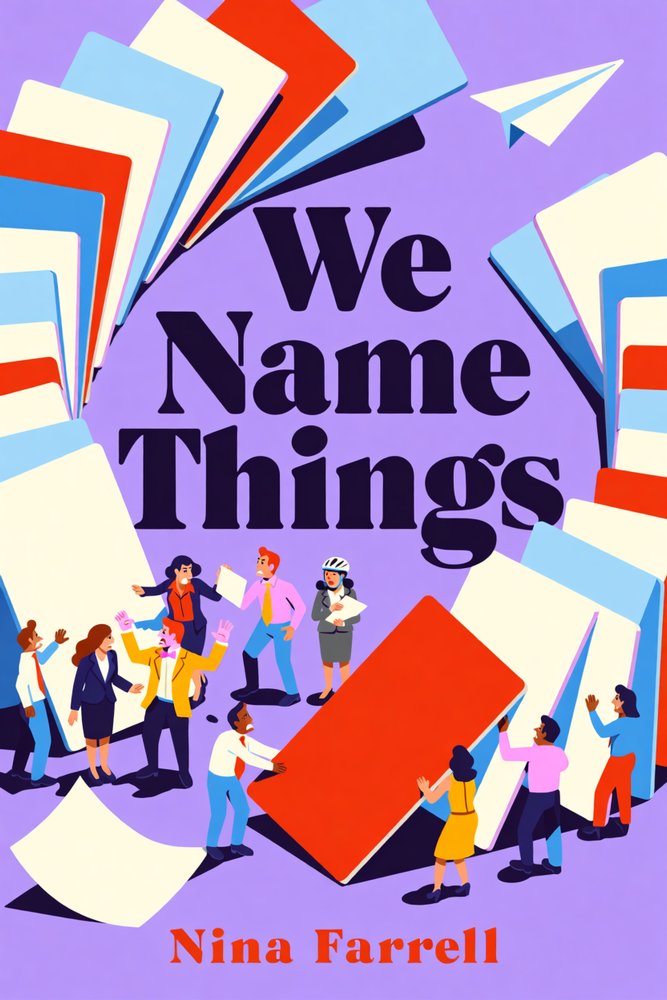
We name things. We named a minivan, two antidepressants, a cereal shaped like a canoe, and a bank that no longer exists. The bank was not our fault. We would like that on the record, and since we are the people who keep the record, it is.
We are Coinage. In the spring of 2009 there were nine of us, if you counted Ben Pritchard, which payroll did not. We worked on the fourth floor of the old Nordquist Button Works in Northeast Minneapolis, a brick building three blocks off Central Avenue that still smelled, on humid days, of warm plastic and machine oil. For sixty years the Nordquist family made buttons there: shirt buttons, coat buttons, and the little ones on cuffs that nobody ever fastens. Now the building held a yoga studio, two architects, a man who restored pinball machines, and us. On the ground floor was Bronek's, a Polish tavern with a pierogi special and a jukebox that had not been updated since the Carter administration. Clients loved the building. They called it authentic. We loved it because the rent was cheap, the windows were tall, and if you stood in exactly the right spot beside the copier you could see a slice of the Mississippi between two parking ramps.
People ask what a naming agency does. They usually ask at weddings, and they usually ask a second time after we have explained it once. Here is the explanation. A company makes a thing. The thing needs a word. The word has to be short and easy to say. It has to be legally available, which in America means no plumbing-supply firm in Delaware got there first. It must not mean anything rude in Spanish, Mandarin, Tagalog, Finnish, or any other language a customer might speak while holding the product. It has to sound like the thing, or like what the thing wants to be, or like what the people who paid for the thing hope it will become when it grows up. Then it has to survive a conference room full of executives, one of whom always has a teenage daughter who thinks it sounds weird.
That is what we do. We find the word.
We found Paddle-Os, the canoe-shaped cereal, which sold well in Wisconsin and nowhere else. We found Equalis and Brightane, the antidepressants, and we are proud of both, though we take no responsibility for the side effects listed in the small print. We found the Sojourn, a minivan that was described by a car magazine as "the most dignified way to carry a soccer team." And we found Prairie Trust Federal, a bank with a lovely name and a less lovely approach to mortgages, which folded the previous autumn in a way that made the evening news. When the bank folded, Rhonda Mazur printed the article, highlighted the phrase "the respected-sounding Prairie Trust," and pinned it to the kitchen bulletin board as evidence that we had done our part.
We have rituals. Every agency has rituals, but ours are better, because ours are old and nobody has ever been allowed to change them.
The first is the Wall. It is a corkboard sixteen feet long that runs the length of the east side of the office, beneath the tall windows. When we are working on a name, every candidate goes up on the Wall, written in black marker on a white index card and fixed with a pushpin. Red pins mean someone loves it. Blue pins mean legal is checking it. Yellow pins mean Alicia Mendoza, our linguist, has concerns, and a yellow pin is never good news. During a big project the Wall becomes a field of white cards so dense you cannot see the cork underneath. Visitors stand in front of it and say "Wow," and we nod as though we are humble about it, which we are not.
The second ritual is the kill meeting. Every Friday at three o'clock, we gather in front of the Wall with coffee or, after four, something stronger from Bronek's. Anyone may argue against any name. When the argument is won, when everyone in the room can feel that a name is finished, someone rings the cowbell, and the card comes down. The cowbell belonged to our founder, Leonard Bascom, who bought it at the Rice County Fair in 1979 for reasons he has never satisfactorily explained. It is brass, dented, and very loud. The sound of it carries through the floorboards. The yoga studio has complained four times. A name that has been belled is dead. We do not resurrect it. We do not say it again in the office except with a certain tone. Over the years, the cowbell has been rung by creative directors, senior namers, strategists, account directors, and, once, by a visiting client from a pharmaceutical company who asked very nicely. It has never been rung by Pam Bender, who has worked at Coinage longer than any of us. This is not a rule, exactly. It is just how it has always gone.
The third ritual is the graveyard. The graveyard is a four-drawer steel filing cabinet, government grey, with a dent in the second drawer where someone kicked it during the minivan project. Inside, in manila folders sorted by year and then by client, is every name Coinage has rejected since 1987. Thousands of them. Rhonda Mazur started the graveyard in her first month at Coinage, when she noticed that dead names were simply being thrown into the recycling bin, and she has maintained it ever since with a devotion most people reserve for grandchildren. She keeps the only key on a lanyard around her neck. She says that one day the graveyard will be worth more than the agency itself. She says that a dead name is just a name waiting for the right product. When we point out that the agency is worth a great deal of money and the cabinet is full of paper, she says, "We'll see," in a voice that ends the conversation.
And then there is the napkin.
By the elevator on the fourth floor, in a gold frame, hangs a paper napkin from a restaurant that closed in 1991. On it, in heavy blue ballpoint, in capital letters, is a single word: CHEDDAROOS. There is a coffee ring on the lower left corner. Below the frame, on a small brass plate, it says: LEONARD BASCOM, 1984.
You know Cheddaroos. Everybody knows Cheddaroos. Orange, crunchy, shaped a little like a kangaroo if you squint, sold in the yellow bag with the cartoon kangaroo wearing a backpack. What you may not know is that the name Cheddaroos appears in nearly every marketing textbook printed in the United States since 1990, usually in a chapter called something like "The Power of the Playful Name." The textbooks tell the same story. A young naming consultant named Leonard Bascom, working alone from a rented room above a dry cleaner, was handed a brief for a new cheese snack. He went to dinner, ordered a beer, picked up a napkin, and wrote the word that would sell four hundred million bags. He took that napkin home, framed it, and built an agency on it. That agency is us.
Leonard sold Coinage to the Pendle Group, a marketing conglomerate in Chicago, in the summer of 2007. Pendle owned fourteen agencies at the time: ad shops, design studios, a firm in Atlanta that did nothing but packaging, and us. Leonard gathered us in front of the Wall to tell us about the sale. He said Pendle was a family of creative people. He said nothing would change. He said that, for him, it was time to see some sunsets. Then he moved to Sarasota, Florida, where he plays golf on a course built around a retention pond full of alligators. Every Christmas he sends a card addressed to "The Gang" and signed "Len," with no other message. Rhonda keeps the cards in a folder in the graveyard, top drawer, under B.
There were nine of us that spring. We should introduce ourselves, because later on it becomes important who was who, and because, for a while, nobody in Chicago could tell.
Alan Whitman was our creative director. He was fifty-two, tall, silver at the temples, and given to oatmeal-coloured sweaters. He had been at Coinage for fourteen years and in charge for ten. He had a calm, deep voice that clients trusted, and he used it to say things like "Let's sit with that" and "What is this name afraid of?" We admired him. Some of us had wanted his job, and some of us had wanted to be his friend, and most of us had settled for knowing his coffee order.
Rhonda Mazur was our senior namer and, by her own appointment, our historian. She was fifty-six. She had come to Coinage in 1987 from a job writing copy for a seed catalogue, and she could still tell you the Latin name of any tomato. She wore reading glasses on a beaded chain and the graveyard key on a separate chain, so that when she leaned over a desk she clinked. She remembered every client, every project, every name, and every slight. She considered herself the keeper of the Coinage flame. It is fair to say that the flame did not always consider her its keeper, but nobody else had applied.
Todd Keene was our other senior namer. He was forty, about to be forty-one, and had come to us from a radio station where he wrote jingles for car dealerships. Todd had the fastest mouth in the building. On a good day he could fill a quarter of the Wall before lunch. He was funny, and loud, and needy in a way that most of us found charming and his wife, Sheryl, had found exhausting. Sheryl and Todd had separated in January. Todd said it was mutual. Pam said it was not.
Alicia Mendoza was our linguist. She was thirty-four and had a doctorate from Indiana, where she wrote a dissertation on how speakers of different languages hear invented words. She spoke six languages herself and kept a network of native-speaker contacts all over the world, people she paid by the hour to tell her whether a name sounded like a body part. Between her own ear and her network, she could screen a name in forty-one languages in about a day. She was quiet, precise, and the only person at Coinage who had ever made Alan Whitman change his mind in a meeting. When Alicia put a yellow pin in a card, we listened.
Kurt Engstrom was our designer. He was twenty-nine and made small, beautiful logos for names that did not yet have clients, so that executives could picture the word on a truck or a box. He rode his bike to work in every season and often forgot to take his helmet off until lunch.
Doreen Pawlak was our account director. She was forty-four and handled the clients, which meant she spent most of her day on the phone saying "Love that" in a warm voice to people whose ideas she did not love. She could kill a client's terrible suggestion so kindly that the client thanked her afterwards.
Mitch Sandberg was our strategist. He was forty-nine and wrote the positioning memos that told us what a name was supposed to do before we tried to name it. He was also the commissioner of a fantasy baseball league with eleven teams, which took up at least as much of his attention as positioning.
Ben Pritchard was the intern. We will come back to Ben.
And Pam Bender was our office manager. She was forty-seven. She had been at Coinage since 1983, when it was Leonard and two other people and a phone. She ordered the supplies, paid the invoices, booked the flights, handled the landlord, fixed the copier, and remembered everyone's birthday. She also knew everything that happened in the building, usually before it happened, which is why we sometimes called her our intelligence service. She sat at the front desk by the elevator, directly beneath the Cheddaroos napkin, behind a large and very old fern that sat in a clay pot on the corner of her desk. Nobody knew where the fern had come from. It had always been there. It was the oldest living thing at Coinage besides Pam, and once, years ago, Rhonda asked if she could catalogue it for the archive. Pam said no, and watered it.
That was us. Nine people, eight of them employed, one cowbell, one napkin, sixteen feet of cork. We named things. We thought it would go on forever, because names do. That is the whole point of them.
We were wrong about that, as it turned out. But we were right about almost everything else.