
Read a preview
Chapter 1
Chapter 1: The Shop on Calle del Ave María
The first shell of the evening landed somewhere near the Puerta del Sol at a quarter past seven, and Isabel Serrano did not look up from the grinding wheel.
She felt it through the soles of her shoes. The jars of polishing rouge on the top shelf chattered against one another, and a thin sift of plaster came down from the ceiling and settled on the counter like flour. Then the shop was quiet again, except for the hiss of the wheel and the steady drip of water into the tin tray beneath it.
The electricity had been off since Tuesday. She worked by two candles set in saucers on either side of the wheel, close enough that she could see the curve of the glass in her fingers, far enough that the wax would not spit on it. The lens was a replacement objective for an artillery rangefinder. A sergeant from the Fifth Regiment had brought the instrument in that morning wrapped in a horse blanket, its left eyepiece cracked through by a splinter. He had stood in the doorway with his cap in both hands, as if he were visiting a church.
"They say you're the only one left in Madrid who can do this," he had said.
"They say a lot of things."
"Can you?"
She had turned the rangefinder over, looked at the brass fittings and the maker's stamp from Jena, and said, "Come back Thursday."
Now it was Wednesday night, and the Nationalists were in the Casa de Campo, and the government had packed itself into motorcars and driven off to Valencia a week ago, leaving behind a defense committee, a great many posters, and the people of Madrid. Isabel pressed the glass to the wheel and counted under her breath. Her father had taught her to count. Ten seconds, lift, check. Ten seconds, lift, check. Glass did not forgive impatience.
The shop had been his for thirty-one years. ÓPTICA SERRANO, the sign over the door said, in brass letters she had polished every Saturday since she was tall enough to reach them with a stepladder. Inside there were two long counters of dark wood, a wall of narrow drawers with ivory labels, a test chart for eyes on the far wall, and, in the back, the workshop: the wheel, the lathe, the polishing laps, the racks of blanks, and the tall stool where Ignacio Serrano had sat every day of his working life until the pneumonia took him in the spring of 1935.
Isabel sat on that stool now. She was twenty-five years old. She had her father's long hands and his habit of frowning at things as though they owed her money. She had her mother's dark hair, which she kept pinned back so it would not fall into the work, and nothing else of her mother, who had died when Isabel was eight and Miguel was not yet one.
Another shell landed, farther off this time, toward the Gran Vía. The candle flames leaned and straightened.
She lifted the lens and held it up between her eye and the nearer candle. The flame swam in it, bent and whole. Almost. There was a faint thickening near the rim, a place where the curve was not yet true. She bent to the wheel again.
*Glass doesn't lie, Isabel,* her father used to say. *People lie. Glass only shows you what's there.*
She had believed that as a child because he said it. She believed it now because she had spent seventeen years learning it was true.
---
At half past eight Señora Encarna came down from the third floor with a pot of chickpea soup wrapped in a dishcloth. She was a widow of sixty with a mustache she did not apologize for and a son in the navy whom she had not heard from since July.
"You haven't eaten," she said. It was not a question.
"I've been working."
"You've been working since the Republic was proclaimed." Encarna set the pot on the counter and took two bowls from the shelf behind it without asking, because she had been taking bowls from that shelf since Isabel's mother was alive. "Is the boy home?"
Isabel switched off nothing, because there was nothing to switch off. She let the wheel slow on its own and wiped her hands on the leather apron.
"No."
Encarna ladled soup. She did not say anything for a while, which was unusual for her, and Isabel understood that the old woman had been counting too.
"Three nights," Encarna said at last.
"Three nights."
"They say the fighting at the University is very bad. They say the Moors got into the Clinical Hospital and our boys are holding the other half of it with their teeth." She pushed a bowl across the counter. "They also say the Russians have sent airplanes, and the airplanes have sent the fascists running back to Burgos, so you can't believe anything they say."
Isabel ate standing up. The soup was thin and tasted mostly of salt, and she was more grateful for it than she could say.
Miguel was seventeen. In August he had walked into a recruiting office on the Calle de Toledo and told a man with a typewriter that he was eighteen, and the man had looked at his peach-fuzz cheeks and his skinny wrists and written it down anyway, because Madrid needed bodies and nobody had time to check. Miguel had come home that night with a rifle older than both of them and a red-and-black scarf from someone he called a comrade, and he had been so proud that Isabel had not been able to shout at him for more than an hour.
Since then he had come home every second or third night. He came in muddy, ate everything on the table, slept twelve hours on the cot in the back room behind the workshop, and went out again before she woke. He told her stories about trenches and singing and a lieutenant who could whistle the whole of the Internationale through his fingers. He did not tell her about the dead, but she saw them on him anyway, in the way he jumped at doors and the way he sometimes sat very still at the table with his spoon halfway to his mouth.
Three nights now, and nothing.
"I'll go tomorrow," Isabel said.
Encarna looked at her over the rim of her bowl. "Go where?"
"To the University. To find him."
"You'll get your head blown off."
"Then you'll have the shop."
"I don't want the shop. I can't see well enough to thread a needle, what would I do with a shop full of glass?" Encarna put the bowl down. "Isabel. Listen to me. You can't go walking into a war like it's the market."
"Half of Madrid walks there every day. The trams run to the front."
"The trams are full of men with rifles."
"Then I'll stand."
The old woman opened her mouth, closed it, and shook her head. She knew the Serranos. She had known Ignacio, who once kept the shop open through a general strike because a schoolteacher on the Calle de la Fe had broken her only pair of spectacles and could not teach without them. She knew there was no point.
---
After Encarna went upstairs, Isabel finished the lens.
It took her until past midnight. She polished it on the pitch lap with cerium oxide and water, slow circles, the candlelight sliding over the wet surface. When she was done she cleaned it with a chamois and a drop of alcohol and held it to the flame again, and this time the flame stood up in the glass whole and sharp, its blue heart clear as a coin.
She set it in a twist of tissue paper in a drawer marked RANGEFINDER, SGT. ÁLVAREZ, and then she went into the back room and stood looking at Miguel's cot.
The blanket was folded the way she had folded it four days ago. His second pair of boots stood underneath, the good ones with the new soles she had paid for in September. His schoolbooks were still stacked on the crate beside the cot: a geometry, a history of Spain, a battered novel about pirates he had read so many times the spine had split. She picked up the geometry. On the flyleaf, in their father's careful hand, it said *Miguel Serrano, his book*, and underneath, in Miguel's scrawl, *and nobody else's*.
She put the book down and took the boots.
Then, because her father had taught her that you should never go anywhere you might need to see clearly without the means to do it, she went back into the workshop and opened the top drawer of his bench. His pocket loupe was there, a ten-power Steinheil in a brass case, worn smooth by forty years of his thumb. She put it in her coat pocket.
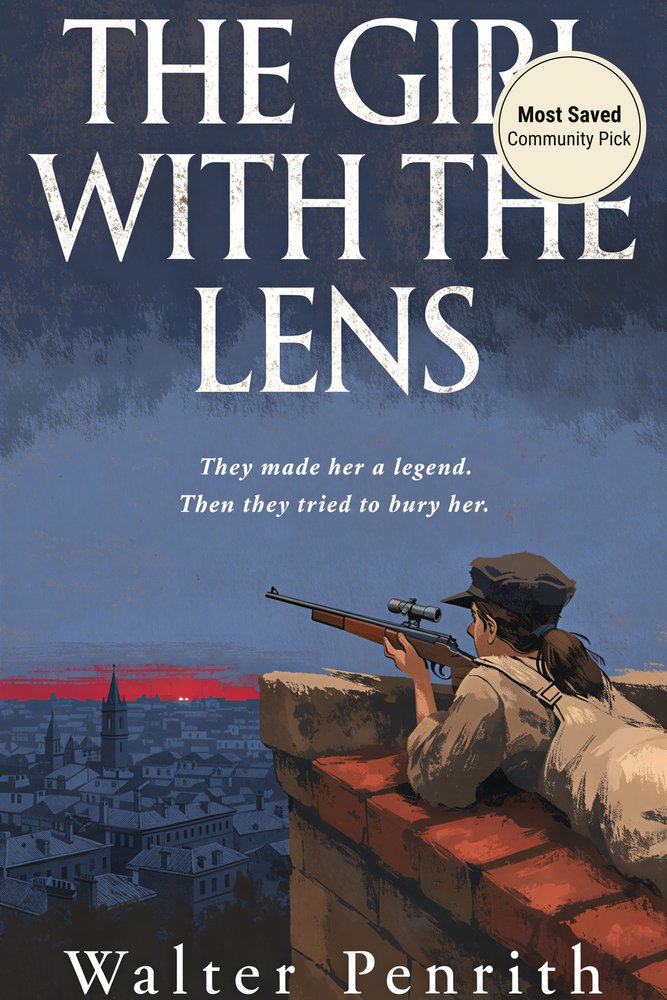
There was one more thing she did before she lay down to sleep. She took down from the wall the small framed photograph of herself at fourteen, standing on a hillside near El Pardo beside her father and a heavy rifle on a tripod. Every summer of her girlhood, Ignacio Serrano had closed the shop for two weeks in August and taken his hunting clients' telescopic sights up into the hills to test them. He would not hand back a scope he had not shot through himself. *You cannot fix a sight you cannot use,* he said. So Isabel had learned to use them. She had lain on her stomach in the dry grass with the cicadas screaming and fired at paper targets on hay bales two hundred, three hundred, four hundred meters away, and then walked down with him to read the holes, and walked back up to adjust the turrets a click at a time until the holes came together like a closed fist.
She had been better at it than he was. He had been delighted.
She looked at the photograph for a while. The girl in it was squinting into the sun and grinning. Isabel did not remember feeling that happy, but the glass said she had been, and glass did not lie.
She put the photograph back on its nail, lay down on Miguel's cot with his boots beside her, and listened to the shells walk slowly across the city until she fell asleep.

