Read a preview
Chapter 1
Chapter 1: The Word
The first thing anyone told me about Celia Morton was that she could say only one word. The second was that the police believed the word was a confession.
Detective Inspector Mark Dawson told me both in the same breath. We were standing in the car park of Coldfall House on the last Monday in March, and rain was running off the edge of his umbrella onto my shoulder. He was a broad man in his fifties with a navy raincoat and a tired, careful face. He had the kind of low, patient voice I suspected he used on suspects and grieving relatives alike.
'Sorry,' he said. 'That's the word. She says it to the nurses. She says it to the physiotherapist. She said it to the woman who brings round the tea. One of the healthcare assistants counted forty-three in an hour last Thursday and then asked to be moved to another ward.'
'Because it upset her?'
'Because of how she says it.' He looked up at the building, a long Victorian house of soot-dark brick with a modern glass wing bolted onto one side. 'You'll hear. I can't describe it. It's like she means it every single time.'
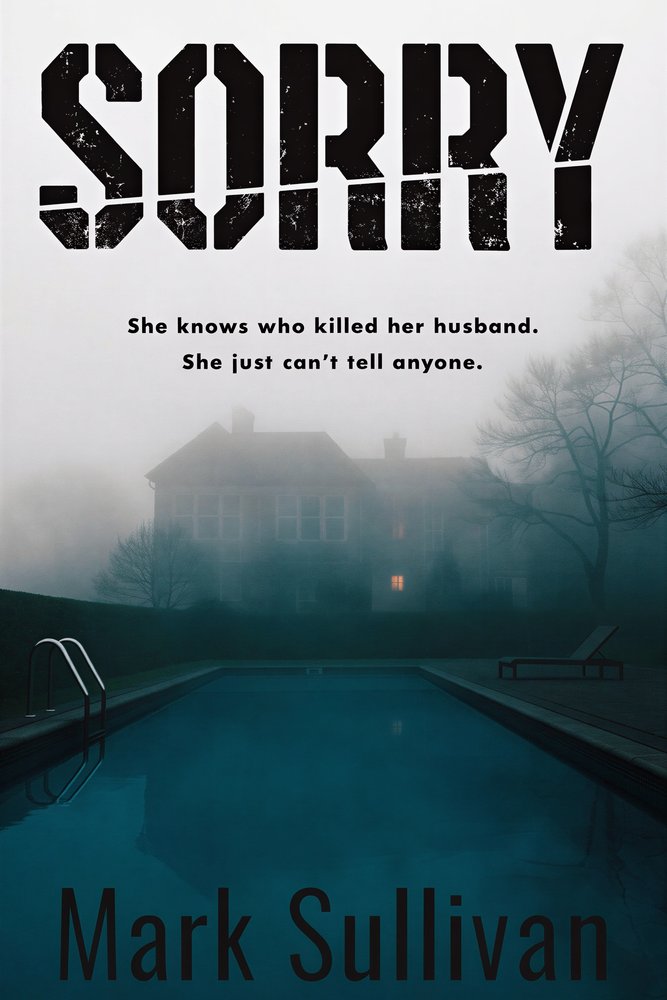
I had read the referral on the train. Simon Morton, fifty-eight, consultant cardiac surgeon, found face down in the heated swimming pool behind his house in Highgate shortly before midnight on Thursday the ninth of March. His wife, Celia Morton, fifty-six, found unconscious on the wet tiles at the pool's edge, a few feet from his body. A massive left-hemisphere stroke. Right side paralysed. Severe expressive aphasia. Comprehension believed to be largely intact. Seventeen days on an acute stroke ward before transfer here, to the specialist neurorehabilitation unit on the edge of Coldfall Wood.
What the referral did not say, because referrals never do, was why a detective inspector from the Major Investigation Team had come out in the rain to meet a Registered Intermediary in a car park.
'You know who she is,' Dawson said.
'I know her books.' Everybody knew her books. Eleven psychological thrillers, translated into thirty languages, two of them made into films I had watched on planes. My mother had a whole shelf of them. Celia Morton wrote about marriages that looked perfect from the street and rotted from the inside, about wives who smiled at dinner parties and planned murders in the shower. Reviewers liked to call her the queen of domestic dread.
'Then you'll appreciate the irony,' Dawson said, 'when I tell you what we found on her laptop.'
He didn't tell me then. He looked at his watch and said he would rather I met her first, with nothing in my head. I liked him a little for that. It was the right instinct, and it was rare.
My job, as I explained to him on the walk to the door, was narrow, and I meant to keep it that way. A Registered Intermediary is not an expert witness. I am not there to give an opinion on whether a witness is telling the truth, or what she really means, or who did what to whom. I am there to assess how a vulnerable person communicates, to advise the police and the court on how to ask questions that person can understand and answer, and to sit beside her during interviews and at trial to make sure those questions are put fairly. I am a bridge. I am supposed to be a very boring bridge. I swear a declaration to be neutral, and I take it more seriously than most people take their wedding vows.
'So you won't tell me what sorry means,' Dawson said.
'I'll tell you what it probably doesn't mean.' I stopped under the porch and shook the rain off my coat. 'With a stroke like this, the part of the brain that plans and produces speech is badly damaged. Sometimes a person is left with a single word or a short phrase that comes out over and over again, whatever they're trying to say. We call it a recurrent utterance. It can be anything. A swear word. A name. One, two, three. I once treated a retired bus driver who could only say Tuesday. He said it when he was hungry and when he wanted his wife and when he was in pain. It didn't mean Tuesday.'
'And you think sorry is one of those.'
'I think it's very likely. It's a common one. It's a word people say automatically, dozens of times a day, without thinking. Those words tend to survive. The brain has worn a deep path for them.'
Dawson considered this. 'So she could be trying to say water, or help, or where's my husband, and out comes sorry.'
'Yes.'
'Or she could be trying to say sorry.'
'That's the problem,' I said. 'You can't tell from the word itself. Nobody can. Which is why it proves nothing, and why I'd ask you not to put it in any report as if it does.'
He gave me a long look, and I knew what he was seeing: a slight, pale woman of forty-three in a sensible grey coat, hair scraped back, a folder held against her chest like a shield. He had probably been told about me. Most police officers in London who dealt with vulnerable witnesses had heard some version of what had happened eighteen months earlier. If he had, he was too polite to say so.
'Noted,' he said. 'Her assistant's here today. Emily Bates. She's worked for Mrs Morton for eight years and practically lives with her. She's been approved as her supporter for any interview. The nurses say she's the only one who can calm her down when she panics.'
'Does she panic often?'
'Every time she sees a police officer,' Dawson said. 'So I'll wait out here.'
Inside, the unit smelled of lemon disinfectant and toast. Through the glass wall of a therapy room I saw a young man in a tracksuit learning to walk between parallel bars, a physiotherapist holding a belt around his waist. A woman in a wheelchair was pushed past me, her face slack on one side, one hand curled in her lap. Somewhere a television was playing a quiz show. It was the same world I had worked in for twelve years as a speech and language therapist before I left the NHS, and walking into it felt like putting on an old pair of shoes.
The senior nurse on the ward, Bola Adewale, met me at the nurses' station. She was a calm, solid woman with reading glasses pushed up into her braids, and she shook my hand firmly.
'You're the intermediary,' she said. 'Good. Somebody needs to find a way in.' She lowered her voice. 'She's all there, you know. Don't let anyone tell you otherwise. She understands every word we say, and she can't get a single one back out.'
'How is she with the sorry?'
Bola hesitated. 'She cries,' she said. 'Not every time. But a lot of the time. Like it's being dragged out of her.' She shook her head. 'I've been on stroke wards twenty years. I've heard every kind of stuck word there is. I've never heard one that sounded like that.'
She led me down a corridor to a single room at the end, with a window looking out onto the wet trees of the wood. The door was half open. Inside, a woman sat in a high-backed wheelchair by the window, and another woman was kneeling beside her, holding her left hand and speaking softly.
The kneeling woman looked up as we came in. She was perhaps thirty-five, with straight fair hair tied back in a low ponytail, no make-up, and a soft green jumper with the sleeves pushed up. She had a kind, open, freckled face, and she smiled at me as if she had been waiting for me all day.
'You must be Lucy,' she said, getting to her feet. 'I'm Emily. Thank you so much for coming.'
Behind her, Celia Morton turned her head.
I had seen her face on the back of a dozen books, sharp and amused, dark hair cut in a sleek bob, a glass of wine in her hand. The woman in the chair was thinner and greyer, the bob grown out and pinned flat on one side where they had shaved it for the scans. The right side of her face drooped. Her right arm lay in a padded support on the armrest, the fingers swollen. But her eyes were exactly the same: dark, quick, and fixed on me with an intensity that made my skin prickle.
She opened her mouth.
'Sorry,' she said.
Dawson was right. I couldn't describe it either, not properly, not even later, when I had heard it a thousand times. It wasn't the flat, mechanical sound I had heard from so many patients with stuck speech. It came out low and cracked and heavy, as if the whole of her had gone into it.
'Sorry,' she said again, and her face crumpled, and her good hand reached out towards me.