
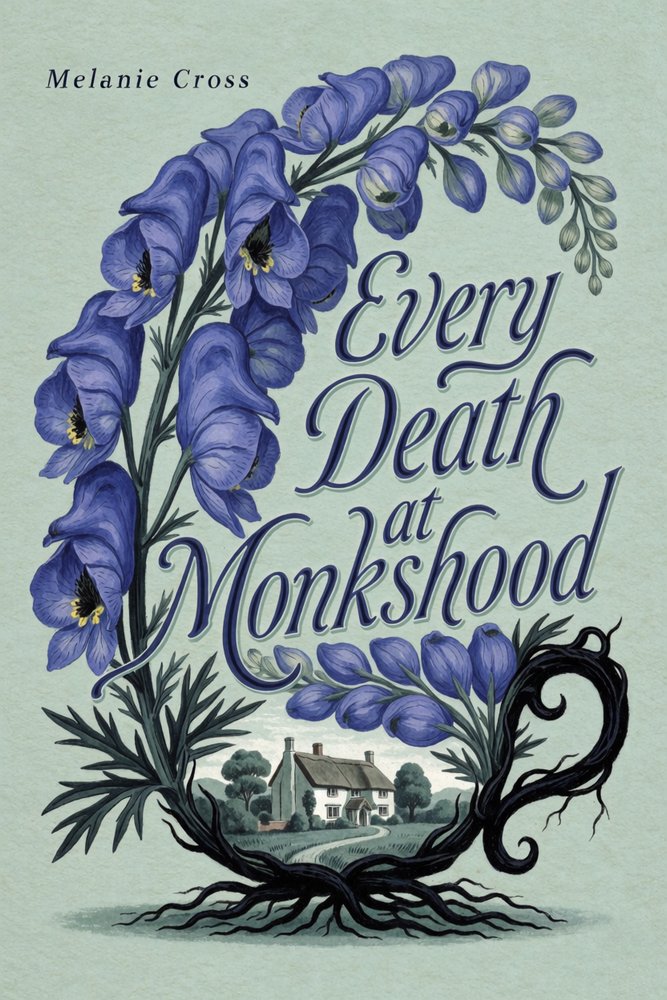
Read a preview
Chapter 1
Chapter One: The Envelope
Mabel Turner woke at seven o'clock on Easter Saturday with the feeling that someone had just left the room.
The little bedroom at the end of the east corridor was grey with early light. The curtains were drawn, as she had left them. The door was shut. Outside, a blackbird was singing in the yew hedge, and far below, in the kitchens of Monkshood Hall, a pan rang against the range. Everything was as it should be, except for the envelope lying on her pillow, an inch from her face.
It was a plain white envelope of the cheap kind sold in any stationer's in Kendal, and there was no name on it. Mabel sat up slowly. She told herself it would be a note from Martha Huggins about the linen, or one of Dame Beatrice's lists. Dame Beatrice often woke at four with an idea and could not bear to wait until breakfast. But Martha always knocked, and Dame Beatrice wrote her lists in green ink on the backs of old proofs and never bothered with envelopes.
Inside was a small glass vial with a cork stopper, the sort a chemist fills with eye drops. A sheet of typing paper was wrapped round it. The note was typed neatly, without a single error.
At midnight tonight you will empty this into Dame Beatrice's silver cup. You will be carrying the cup in any case, so nobody will think it strange that your hands were on it.
If you do not, the police will be told how Albert Wicks died: a depressed fracture of the left temporal bone, two inches above the ear, made with a brass poker in the front room of No. 9 Fellside Terrace, Kendal, on the night of the fourteenth of March 1928. They will be told where to find his wife.
Burn this.
She read it three times. The first time the words did not go in at all. The second time they went in like cold water. The third time she made herself read slowly, the way Dame Beatrice had taught her to read a proof, one line at a time, as if each word might be lying.
Albert Wicks. Nobody had said that name to her in three years. She had not said it herself, not even in the dark.
She had been Lily Wicks then, twenty-three years old and married four years to a man who mended bicycles in a yard off Highgate and drank his takings at the Fleece on Saturday nights. She had learned the sound of his boots on the stairs the way a farmer's wife learns the weather. On the fourteenth of March he had come home early and found that she had spent two shillings on a library ticket. He broke a chair first. Then he started on her. She remembered the poker in her hand, and very little of the moment before it. She remembered the dull sound it made, and Albert sitting down on the hearthrug as though he had suddenly felt tired. She remembered that he was still breathing.
She had taken her coat and the money from the tea caddy and walked to the station in the rain. Four days later, in a café in Lancaster, she had read in a newspaper someone had left on the table that Albert Wicks of Kendal had died in the infirmary of head injuries, and that the police wished to speak to his wife.
The newspaper had said head injuries. It had not said which side of his head, or how many inches above the ear. She had cut the report out and hidden it in the lining of her trunk, and she had read it so often that she knew every word. None of those words were left temporal bone.
Whoever had written this note knew more than the newspapers did.
She got out of bed. Her legs felt as if they belonged to someone else. She went to the window and looked down at the lawn, where Jack Seddon and the gardener's boy were already building the bonfire, dragging branches across the wet grass. Beyond the lawn the ground fell away to the lily pond and the old chapel with its squat bell tower, and beyond that the fells rose brown and grey into a dull white sky. It was the same view she had seen every morning for two years. It looked different now. It looked like a place where she was going to be caught.
After Lancaster she had become Mabel Turner. Mabel had been her mother's name and Turner her grandmother's, and nobody asked to see the birth certificate of a girl who could type sixty words a minute. She had worked in a typing bureau for a year, sleeping in a room above a pork butcher's, and then she had answered an advertisement in The Times. Lady novelist requires secretary. Must be discreet, accurate and not easily shocked. Dame Beatrice Wetherell had looked at her over her spectacles for a long, silent minute, asked her to type two pages of a chapter in which a vicar was poisoned with arsenic in his cocoa, and given her the post that same afternoon.
That was two years ago. In that time Mabel had typed four novels, answered a thousand letters from readers, learned the difference between belladonna and henbane, and very nearly forgotten to be afraid.
She looked at the vial. The liquid in it was as clear as water. She did not take out the cork. She wrapped it back in the note, slid both into the envelope and pushed it to the bottom of her stocking drawer, under the darned pair she never wore. Then she washed in cold water, pinned up her hair, put on her grey wool dress and went downstairs, because it was a quarter past eight and Dame Beatrice would be waiting.
Monkshood Hall had been built in the time of Queen Elizabeth by a family who made their money in wool and lost it in religion. It was long and low and made of grey stone, with a great hall in the middle, two wings that did not quite match, and a great many staircases that went nowhere useful. The name came from the flower. Monkshood grew wild in the old physic garden behind the chapel, tall and handsome, with hooded purple blooms like a row of little monks. Every part of it was poisonous. Dame Beatrice said that was the reason she had bought the house.
The study was at the end of the south wing, a long room lined with books, with a fire that was never allowed to go out and a desk the size of a farm cart. Dame Beatrice sat behind it in a high-backed chair with a rug over her knees. She was seventy-one years old. Her hands were twisted with arthritis, she walked with a stick, and her heart was weak enough that she took digitalis drops in a glass of water three times a day and complained about the taste. Her eyes, however, were as bright as a blackbird's. For twenty years they had looked down a microscope at the Home Office, picking strychnine and arsenic out of the remains of murdered men. Then she had retired, sat down at a typewriter and spent thirty years putting what she knew into novels. Her detective, Inspector Ellwood, had solved forty-two cases, and the whole of England had read every one.
'You look dreadful,' said Dame Beatrice. 'Did you sleep?'
'Not very well,' said Mabel. 'The wind kept me awake.'
'There wasn't any wind.' Dame Beatrice peered at her. 'Never mind. Sit down. We've a great deal to get through and I want letters finished by ten. Martha wants the hall for the decorations, Catherine wants to listen to my heart, and Edwin wants to talk to me about money, which is the one thing I have never wished to discuss with Edwin.'
Mabel sat at the small desk by the window where her typewriter lived. Her hands found the keys out of habit. She typed replies to three admirers, to a vicar in Devon who wanted to know whether a parsnip could be mistaken for hemlock, and to a solicitor in London. Every few minutes she looked up at the old woman by the fire and thought: someone in this house wants you dead, and they want me to do it for them.
She thought of telling her. The words were in her mouth. Dame Beatrice, I found this on my pillow. But then Dame Beatrice would ask why anyone imagined a secretary could be forced to poison her employer, and Mabel would have to answer, and the answer was Albert sitting down on the hearthrug.
'Mabel.'
She jumped. 'Yes?'
'You've typed Dear Sir four times.' Dame Beatrice was watching her with her head on one side. 'Is something wrong? You may tell me, you know. I've heard most things.'
'It's nothing,' said Mabel. 'Only the party. There's so much to do.'
'There is.' Dame Beatrice let it go, which was not like her. She looked into the fire. 'It's my last, you know. I shan't see another Easter. Catherine won't say so, but I know what my own heart sounds like. So I mean to do it properly. The ball, the bonfire, the cup at midnight, and then tomorrow at breakfast I shall read them the final chapter.'
Mabel had typed every chapter of The Last Vigil except that one. Dame Beatrice had written it herself in January, alone in the study with the door locked, on the old Remington she had not used since before the war, picking out the letters with two crooked fingers. It lived in the top drawer of the desk, and the key to the drawer hung on a black ribbon round Dame Beatrice's neck.
'Is it a good ending?' Mabel asked, because she had to say something.
Dame Beatrice smiled without much pleasure. 'It's a true one. That isn't always the same thing.' She turned her head and looked straight at Mabel. 'There are people in this house who won't enjoy hearing it. But I've kept quiet for eighteen years, and I find I'm tired of it. Tomorrow I shall stop.'
Then she clapped her twisted hands together, winced, and asked for the post.

