Read a preview
Chapter 1
Chapter 1: One Last Real Adventure
Rob Collins had saved Luke Turner's life when they were fifteen, and in the twenty-six years since, he had never once asked for anything in return.
So when Luke climbed the stairs to his rented unit at seven in the morning, still in his green paramedic uniform and smelling of hospital hand gel, and found Rob sitting on the top step with a cardboard map tube across his knees, he knew something was coming before either of them said a word.
"You look like hell," Rob said.
"Night shift." Luke dug for his keys. "What are you doing here? It's seven o'clock."
"I know what time it is. I've been here since six. Your neighbor thinks I'm a burglar. She's been watching me through the blinds for an hour."
"She thinks everyone's a burglar."
Luke let them in. The unit was small and plain, with a kitchen that looked onto a car park in North Hobart. Six months after he had moved in, there were still cardboard boxes stacked against the wall of the lounge room, labeled in Megan's neat handwriting. *Books. Kitchen. Luke, winter.* He kept meaning to unpack them. He kept not doing it.
Rob looked at the boxes and said nothing, which Luke appreciated. He filled the kettle while Rob prowled the room. Rob had never been able to sit still. At forty-one he was still lean and brown, with a mess of curly hair gone gray at the temples and a grin that made strangers trust him. He was thinner than Luke remembered, though. His jeans hung loose on him, and there were shadows under his eyes that hadn't been there at Christmas.
"Bad night?" Rob asked.
Luke thought about it. A cardiac arrest in Moonah, an old man on his kitchen floor whose wife had kept doing compressions until the ambulance arrived. They had worked on him for forty minutes. He had not come back. After that, a teenage boy with a broken wrist from a skateboard, who had cried more about his phone screen than the bone. Then a woman in Glenorchy who had fallen in the shower and lain there for two days.
"Normal night," Luke said. "What's in the tube?"
Rob's grin came out like the sun from behind a cloud. He cleared a space on the kitchen table, pulled the cap off the tube and unrolled a topographic map, weighing the corners down with Luke's salt shaker, a coffee mug and two oranges from the fruit bowl.
The map showed the southwest of Tasmania, the great blank wilderness that took up a quarter of the island. Luke knew it the way most Hobart people knew it: as a green space on the map with very few roads, where the weather came from. Rob had drawn on it in red pen. A dotted line climbed from the end of an old Hydro road, crossed a range of hills, and dropped into a valley. From there a thick red line followed a river that twisted south and west through the contour lines for nearly a hundred kilometers before it joined a bigger river near the coast.
"The Carnac," Rob said. He tapped the red line. "Nobody's run it in ten years. The last party was a bunch of Victorians in 2014, and they walked out halfway because one of them did his knee. Before that, maybe three trips ever. It's packraft country, mate. Too remote for big boats. You walk in, you blow up your raft, you paddle out."
Luke leaned over the map. The contour lines around the river crowded together in places until they were almost solid brown.
"That's steep," he said.
"That's the Gates." Rob's finger moved to the bottom of the river, where the lines pinched tightest. "Granite gorge. The whole river squeezes down between two walls you could touch with both paddles. Then it spits you out onto the Raglan, and from there it's two easy days of flat water down to the old Hydro bridge. My cousin can pick us up."
"And this?" Luke touched a spot in the middle of the river where Rob had drawn a small red star.
Rob's voice went softer. "That's the Elder Flat. There's a stand of Huon pines there that nobody's ever logged. Some of them are two thousand years old, Luke. Two thousand. They were seedlings when the Romans were building roads. You can walk among them. You can put your hands on them."
Luke looked at his friend. Rob had always been like this. When they were boys, it had been a rope swing over the Huon River, then a canoe trip down the Picton, then a motorbike they had rebuilt in Rob's dad's shed and crashed in the first week. Rob ran ahead. Luke came after with the first-aid kit. That was how it had always worked.
"How long?" Luke asked.
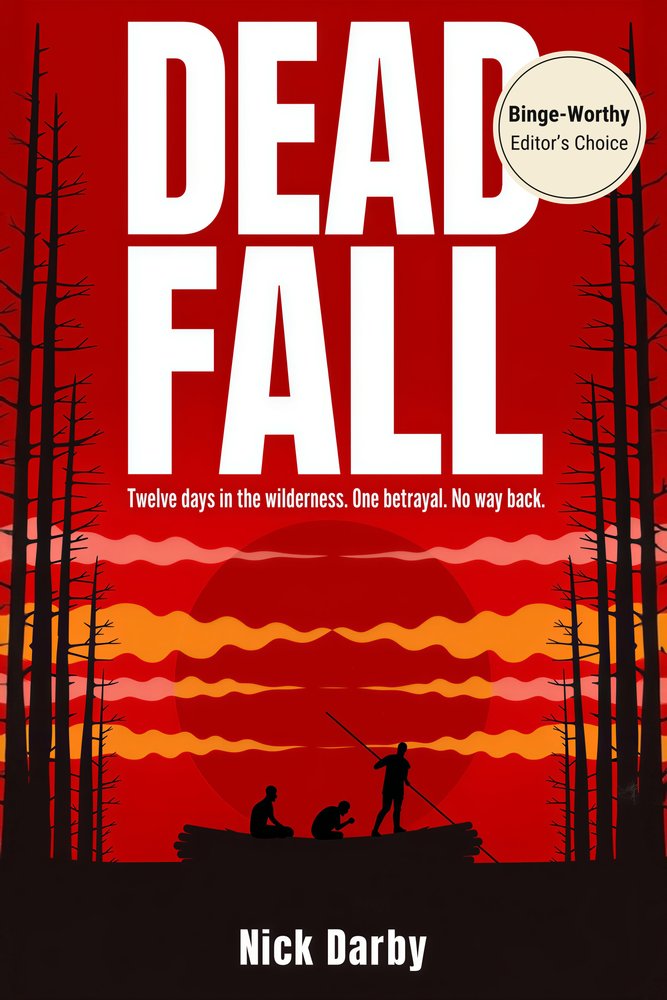
"Twelve days. Two to walk in, eight or nine on the river, a couple of spare days for weather." Rob looked up from the map. "Come on. You've got leave owing. You told me at Christmas you had about a year of it."
"Eleven weeks."
"There you go. Your boss has been begging you to take it since..." Rob stopped.
"Since Megan left," Luke said. "You can say her name. We didn't have a war. We just ran out of things to say to each other."
"Which is worse, if you ask me."
"Nobody asked you."
Rob laughed, and Luke found himself smiling too. The kettle clicked off. He made two cups of instant coffee and sat down at the table with the map between them, and for a while neither of them said anything.
---
The flood had come in the September they were fifteen.
It had rained for a week, and the creek that ran behind Rob's family's apple orchard outside Huonville had turned from a trickle into a brown, roaring thing that carried whole branches past at the speed of a running dog. Rob had wanted to see it up close. Luke had told him it was a stupid idea and then followed him anyway, because that was how it worked.
Luke was the one who slipped. The bank gave way under his sneakers, and suddenly the cold took his breath and the water was over his head. Something caught his ankle and held it: an old wire fence that had been swallowed by the creek. He remembered the strange calm of being under the water, the brown light, the roar gone dull and far away. He remembered thinking very clearly, *This is how I die.*
Then a hand had grabbed the back of his jacket. Rob had jumped in after him, found the fence by feel, and torn the wire loose with his bare hands. They had crawled out onto the bank together, coughing and shaking, Rob's palms cut and bleeding.
Rob had looked at him, gasping, and started to laugh. "You owe me a Coke," he'd said.
Luke had bought him one that afternoon at the milk bar in Huonville. He had decided, without telling anyone, that he wanted to be the person who knew what to do when things went wrong. Ten years later he had his paramedic qualification. Rob had come to the graduation in a borrowed suit and cheered so loudly the dean had stopped speaking to look at him.
---
"What about the business?" Luke asked now.
Rob's face shut for a moment, then opened again. Collins River Co. had run rafting trips on the Franklin for eight years. It had a website, a bus with a painted platypus on the side, and a reputation for the best campfire food in the state. Then two years ago it had all come apart: a bad season, a broken gearbox, an insurance premium that had tripled after a client broke her arm. Rob had sold the rafts and the bus and moved into a room above a pub in Cygnet. Since then he'd guided wherever someone would hire him, from New Zealand to the Kimberley.
"The business is dead," Rob said. "I'm between things. I had a season lined up in Queenstown, the Kiwi one, and it fell through."
"How are you paying for this?"
"I've got a bit put aside." Rob shrugged, and his eyes slid to the map. "It's not expensive. Food, fuel, a few new dry bags. I've got both rafts already. All you need to bring is yourself."
"And the first-aid kit."
"And the first-aid kit," Rob agreed. "You always do."
Luke looked at the map. He looked at the boxes against the wall with Megan's handwriting on them. He thought about the old man on the kitchen floor in Moonah, and about how many nights he had come home to this small quiet room and sat in the dark without turning on the television.
"What's the water like?" he asked. "It's been dry. It's going to be hot this week. They were talking about a total fire ban on the radio."
"It's rainforest, mate," Rob said. "It's wet down there even in a drought. The river's spring fed at the top. It'll be low, but low is good on a river like this. Low means we can see the rocks." He put his hand flat on the map. "Come on, Luke. One last real adventure. Before we get old."
"We're forty-one."
"Exactly," Rob said.
Luke laughed. It surprised him. He had not laughed much in six months.
"All right," he said. "I'll talk to my boss."
Rob whooped so loudly that the neighbor banged on the wall. He grabbed Luke by the shoulders and shook him, and for a second, with the morning sun coming in through the window and the map spread out on the table, they were fifteen again and the whole world was a creek to be crossed.
Later, after Rob had gone, Luke found that he had left the map on the table. In the corner, in pencil so faint it was almost invisible, someone had written a row of numbers beside the red star at the Elder Flat. Coordinates, Luke thought. He didn't think about it again for a long time.