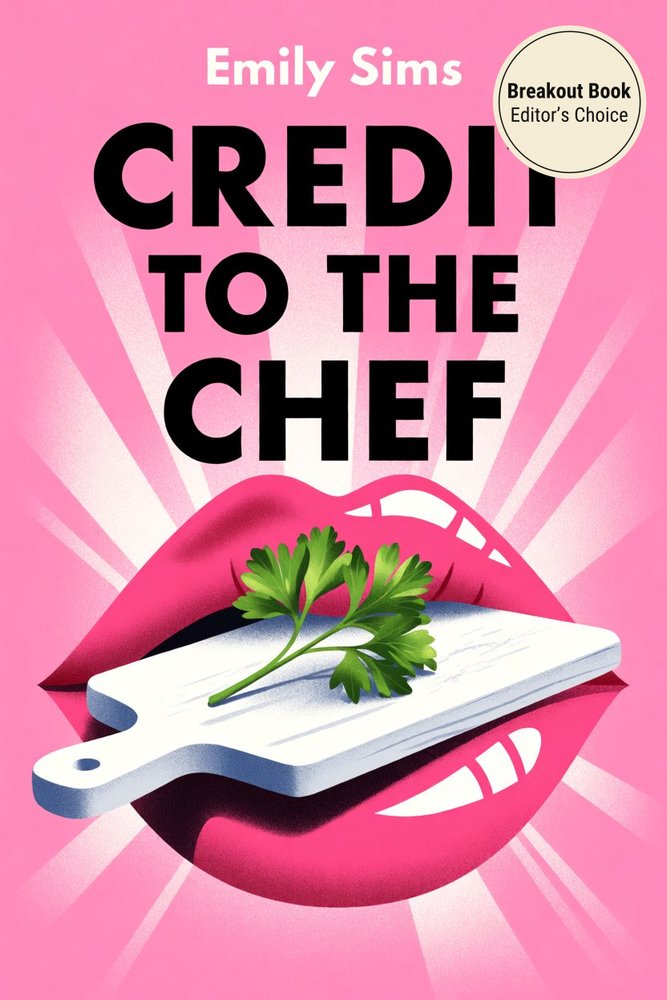
Read a preview
Chapter 1
Chapter 1: Yield Management with Napkins
The thing about Bobby Scola was that he could make you believe anything, as long as you were eating.
He could make you believe that a single razor-thin slice of hamachi draped over a smear of yuzu kosho and three drops of something he called "ancestral soy" was worth forty-two dollars. He could make you believe that the bread course—bread, for God's sake, the thing monks invented because they were bored and had wheat—was a "meditation on grain." He could make you believe that Bobby Scola, thirty-six years old, executive chef of The Mercer Room in Tribeca, was a genius.
He was, in fact, talented. Genuinely, irritatingly talented. His knife work was surgical. His instincts for acid and heat were so precise that his line cooks sometimes watched him adjust a sauce with the same slack-jawed reverence usually reserved for watching someone parallel park a bus. He could taste a broth and tell you not just what was missing but what was about to go wrong, as though the future of a soup had confided in him personally.
But Bobby's talent was like a beautiful sports car with no brakes and a raccoon at the wheel. It went fast, it looked incredible, and it was absolutely going to kill somebody.
He stole recipes from his sous chefs the way other people borrowed pens—casually, without acknowledgment, and with no intention of returning them. He seduced the assistants of food critics, not for love or even lust, but for advance knowledge of review timelines. He referred to the diners at The Mercer Room as "the marks," a habit that would have gotten him fired at any restaurant run by a person with functioning ethics.
The Mercer Room was not run by a person with functioning ethics.
The Mercer Room was run by Todd Bixby.
Todd Bixby was a hedge-fund creature who had purchased the restaurant four years earlier because he had read an article in a first-class airline magazine about how "the new luxury is experiential" and had decided that owning a restaurant was basically the same as owning a racehorse, except you could eat at it. He had three homes—Tribeca, East Hampton, Aspen—two divorces, and a belief system that could be summarized as: everything is an asset, everyone is a line item, and hospitality is just yield management with napkins.
Todd visited the restaurant approximately twice a week, usually between 9:00 and 9:45 p.m., wearing a vest over a dress shirt with no tie, which he believed made him look approachable. He would stand in the dining room doorway with his hands clasped behind his back, surveying the tables like a plantation owner who had recently pivoted to artisanal cotton.
"How's the yield tonight?" he would ask the maître d', a long-suffering Frenchman named Pascal who had worked at three-star restaurants in Lyon and Paris and was now being asked about yield by a man who once referred to foie gras as "liver candy."
Pascal would give Todd the cover count. Todd would nod. Todd would say something about "conversion rates" or "dwell time" or, once, memorably, "customer lifetime value," which caused Pascal to excuse himself to the wine cellar where he stood among the Burgundies and quietly questioned every decision that had led him to this continent.
On the evening that everything began to go wrong—or right, depending on your feelings about Bobby Scola—Todd arrived not at 9:00 but at 6:15, before service, carrying a bottle of Barolo that cost nine hundred dollars and wearing the facial expression of a man about to deliver bad news while pretending it was an opportunity.
Bobby was in the kitchen, doing what Bobby did before service: standing at the pass with his arms crossed, watching his brigade work, and periodically saying things like "That's not a brunoise, that's a cry for help" and "If I wanted it that color, I'd have asked you to disappoint me."
He was, by the standards of professional kitchens, not the worst boss in the world. He did not throw pans. He did not scream. He simply had a way of looking at your work that made you feel like you had personally betrayed the entire history of French cuisine, and also his mother, and also the concept of trying.
"Chef," said the expediter, a woman named Dani who had the thousand-yard stare of someone who had been calling out ticket times for three years. "Todd's here. He's got wine."
"What kind?"
"The kind that means we're in trouble."
Bobby found Todd in the private dining room, which Todd called "the war room" because he had seen too many movies about himself. The Barolo was open. Two glasses were poured. Todd was sitting with one ankle crossed over the opposite knee, a pose he had practiced in a mirror.
"Bobby," Todd said, gesturing at the chair across from him. "Sit. Drink. Let's talk about the future."
"The future of what?"
"The future of this restaurant. Which is, as of this quarter's numbers, looking a lot like a members-only pickleball lounge."
Bobby sat.
Todd explained. The Mercer Room was hemorrhaging money. Not bleeding—hemorrhaging, which Todd emphasized by making a gesture with both hands that was apparently meant to represent arterial spray but looked more like he was describing a large fish. Covers were down eighteen percent year-over-year. The prix fixe wasn't moving at the price point they needed. The wine program was overbuilt. The staff costs were, in Todd's words, "unsustainable in the current macro environment," a phrase that meant "I don't want to pay people."
"We've got one Michelin star," Todd said, swirling his Barolo with the confidence of a man who could not tell Barolo from Bud Light if his life depended on it. "One star is nice. One star is fine. One star is also, frankly, Bobby, a participation trophy. We need two."
"I'm aware."
"The guide announcement is in five months. If we land a second star, I will personally fund a full renovation. New kitchen. New everything. I'll even look at a second location. Bobby Scola, empire builder. How's that sound?"
It sounded like a man dangling a steak in front of a dog. Bobby knew this. Bobby also knew that he was, in this metaphor, the dog.
"And if we don't get it?" Bobby asked, though he already knew.
Todd uncrossed his ankle. Recrossed it the other way. Took a sip of wine that probably cost forty dollars per sip.
"Then I'm converting this space. I've already had conversations. Pickleball is the fastest-growing sport in America, Bobby. The fastest-growing. And the membership model is incredible. Recurring revenue. Branded merchandise. A smoothie bar. It's basically a license to print money, except the money comes from divorced dads in compression shorts."
"You're going to turn my kitchen into a pickleball court."
"Courts, plural. We can fit four. Maybe five if we lose the wine cellar."
Bobby drank the Barolo. It was extraordinary—dark fruit, leather, tar, the kind of wine that made you briefly believe the world was a good and beautiful place, which it was not, because the world contained Todd Bixby and pickleball.
"Five months," Bobby said.
"Five months. Get me that star, Bobby. Or start practicing your backhand."
Todd laughed at his own joke. Bobby did not.
After Todd left, Bobby stood alone in the private dining room and did what he always did when confronted with a crisis: he thought about his ex-wife.
Rina Scola—she'd kept the name, which Bobby found both flattering and infuriating—had gotten the Brooklyn trattoria in the divorce. It was a small place in Carroll Gardens called Scola's, which had been Bobby's family name and was now, through the alchemy of matrimonial law, Rina's brand. She served simple Italian food. No tasting menu. No tweezers. No imported Japanese charcoal. No one in her kitchen had ever used the phrase "fermentation program" in a meeting, because she did not have meetings. She had family meal and then service and then a glass of wine and then bed, a schedule so sane that Bobby found it personally offensive.
Scola's was packed every night.
Every single night.
Bobby told himself this was because people were stupid. People didn't want to be challenged. People wanted red sauce and garlic bread and a waiter who called them "sweetheart" and a check that didn't require a second mortgage. People wanted comfort, not art.
This was, of course, the kind of thing a person says when they are losing and cannot admit it.
The truth—the real truth, the one that Bobby kept locked in a vault somewhere behind his sternum—was that his food had gone stale. Not bad. Never bad. Bobby's worst dish was still technically excellent, the way a corporate law firm's holiday party is technically a party. But the spark was gone. The menu at The Mercer Room read like a greatest-hits album from a band that peaked in 2019: competent, familiar, and vaguely depressing.
Everyone knew this except Bobby.
Sal Vitale, Bobby's sous chef and the longest-surviving member of his kitchen—ten years, a tenure that spoke less to loyalty than to Sal's complete inability to update his résumé—knew it. Sal was fifty-three, built like a fire hydrant, and possessed of a face that suggested he had been disappointed by every single thing that had ever happened to him, including his own birth. He was a saucier of genuine skill, a man who could build a mother sauce in his sleep and had, on at least one occasion, literally done so during a double shift.
Sal knew the food was stale because Sal made most of it, and Sal was also stale, and Sal was fine with this, because Sal had given up on joy approximately fifteen years ago and was now just trying to get to his pension without Bobby giving him an ulcer.
Dani knew it. Pascal knew it. The line cooks knew it. The dishwashers knew it, and dishwashers usually didn't know anything about the food because they experienced it only as a film on plates.
Bobby did not know it because Bobby had constructed, over the course of a fifteen-year career, an airtight psychological fortress in which he was always the smartest person in the room, his food was always the best food in the room, and any evidence to the contrary was the result of other people being jealous, stupid, or both.
This fortress was about to get a visitor.
The solution to Bobby's problems walked into his kitchen on a Tuesday morning in March, wearing checked pants that were slightly too short and carrying a knife roll that looked like it had been purchased at a yard sale, which it had.
His name was Eddie Doyle.
He was twenty-four. He was from Providence. His résumé, such as it was, listed three years as a dishwasher at two restaurants no one in New York had heard of, a six-month stint at a seafood shack, and, under "Special Skills," the word "tasting."
Just "tasting."
He had applied for a stage—an unpaid training position, the culinary world's version of an internship, except with more burns and less hope—and had been accepted because The Mercer Room's HR process consisted of Sal reading an email, shrugging, and saying, "Sure, we need a body."
Eddie was thin and quiet, with the kind of face that people forgot immediately after looking at it, which was, as it turned out, extremely useful. He had brown hair that he kept under a beanie until service, at which point he switched to a kitchen skull cap. He said "yes, chef" and "no, chef" and "thank you, chef" and almost nothing else.
For his first week, he did prep work. He peeled. He diced. He broke down cases of produce with the silent efficiency of a person who had spent a lot of time being invisible and had gotten very good at it.
Bobby barely noticed him.
Then came family meal.
Family meal at The Mercer Room was a daily exercise in institutional sadness. Whoever was assigned to cook it treated it as a punishment, which it was. The results were usually a steam-table tray of overcooked pasta or a sheet pan of chicken thighs prepared with all the love and care of a DMV transaction.
On Eddie's eighth day, he was assigned family meal. This was a hazing ritual. New stagiaires always got family meal. The expectation was mediocrity.
What Eddie produced was a clam broth.
It doesn't sound like much. Clam broth. Two words. The kind of thing you'd find on a diner menu between "cup of soup" and "giving up."
But this clam broth had burnt lemon and celery leaf, and it was the single most perfectly balanced liquid that anyone in that kitchen had ever put in their mouth.
The line cooks went silent.
This was notable because line cooks are never silent. Line cooks are, as a species, loud. They talk constantly. They talk about sports, about hangovers, about the hostess, about the sous chef's divorce, about the time someone found a mouse in the walk-in. They talk while they work, they talk while they eat, they talk while they are being yelled at. Silence from a line cook is like silence from a parrot: it means something extraordinary or terrible has happened.
In this case, extraordinary.
Bobby was in his office—a closet with a desk, a laptop, and a framed review from 2017 that he read the way some people read scripture—when Sal appeared in the doorway.
"You should come taste something," Sal said.
Sal never said this. Sal's relationship to food at this point in his career was purely transactional, like a bus driver's relationship to roads. For Sal to recommend tasting something was like a postal worker recommending a letter.
Bobby followed him to the staff table, where a pot of broth sat next to a basket of bread and a bowl of charred cabbage with anchovy butter and pickled apple.
Bobby tasted the broth.
He tasted the cabbage.
He said nothing.
Then he tasted the broth again.
"Who made this?" he asked.
"New kid," Sal said. "The stage. Doyle."
Bobby looked across the kitchen at Eddie, who was washing a pot and had not looked up. Bobby tasted the cabbage again. The anchovy butter was extraordinary—rich and funky and cut perfectly by the pickled apple, which had a brightness that made the whole dish vibrate.
"Huh," Bobby said.
This was, from Bobby, the equivalent of a standing ovation.
The next day, Eddie made a family meal of pork shoulder—a cheap cut, the kind of thing Bobby would never put on his menu because it wasn't expensive enough to justify a forty-dollar plate. Eddie braised it low and slow with something that smelled like black cardamom and fish sauce and brown butter, and when Bobby tasted it, standing over the pass in his chef's whites, he ate three bites and briefly saw God.
Not metaphorically. Bobby Scola, a man who believed in nothing except his own talent and the transformative power of truffle oil, experienced a momentary spiritual event over a piece of pork shoulder prepared by a twenty-four-year-old kid from Providence.
Then, because he was Bobby, he immediately started thinking about plating options.
Bobby recognized genius the way a wolf recognizes a lamb: with hunger, with calculation, and with the absolute certainty that the genius in question existed primarily to serve Bobby's purposes.
So he did what Bobby did.
He called Eddie into his office, which took some doing because Eddie had to squeeze past a shelf of cookbooks that Bobby displayed but never read.
"Eddie," Bobby said, leaning back in his chair with the studied casualness of a man about to commit intellectual property theft. "That pork shoulder. Walk me through it."
Eddie walked him through it. The black cardamom. The fish sauce. The way he rendered the fat cap separately and used it to baste. The resting time. The temperature.
Bobby nodded throughout, not because he was learning—Bobby's ego would never permit learning—but because he was memorizing.
"Good instincts," Bobby said. "Raw, but good. Here's what we're going to do. I'm going to develop a version of that dish for the tasting menu. My version. Refined. Elevated. You'll assist."
"Your version," Eddie repeated.
"That's how apprenticeship works, kid. You bring the clay. I make the sculpture. Someday, you'll have your own kitchen, and some kid will bring you clay, and you'll understand."
Eddie looked at Bobby for a long moment. His face was unreadable, which Bobby interpreted as awe.
"Yes, chef," Eddie said.
Within two weeks, Bobby had put four of Eddie's dishes on the tasting menu under his own name. The clam broth became "Bobby Scola's Littleneck Consommé with Charred Citrus." The cabbage became "Brassica, Anchovy, Apple: A Study in Umami." The pork shoulder became "Heritage Pork, Spice Route Braise," which was the kind of name that made food writers nod and diners feel like they were eating something important.
The dining room came back to life.
It happened fast. Within a month, the regulars—the ones who had been coming less frequently, the ones who had started going to other places and making excuses—began returning. They brought friends. They brought the kind of friends who had money and opinions, which in Tribeca was everyone.
Reviews warmed up. A food blogger with two hundred thousand followers posted a photo of the pork dish with the caption "Bobby Scola is BACK" and three fire emojis, which in the modern culinary economy was the equivalent of a rave review in the Times.
Word spread that a Michelin inspector had visited. Twice.
Todd Bixby began appearing in the kitchen doorway during service, watching the plates go out with the moist, possessive glow of a man whose asset might not become pickleball after all. He would stand there, vest gleaming, nodding at each dish as though he had personally cooked it, which, in the sense that he was paying the electricity bill, he sort of had.
"This is what I'm talking about," Todd would say to no one. "This is conversion."
Pascal, passing with a wine list, would mutter something in French that was almost certainly not a compliment.
And Eddie Doyle, the architect of all of it, continued to work silently at his station, saying "yes, chef" and "no, chef" and "thank you, chef," and watching everything with eyes that missed nothing.
Sal noticed.
Sal noticed because Sal, despite his exhaustion and his bad knees and his deep, abiding wish to be literally anywhere else, was not stupid. Sal had survived ten years in Bobby's kitchen by being the kind of person who saw everything and said almost nothing, a survival strategy he shared with housecats and Cold War spies.
"Bobby," Sal said one night after service, while they were drinking beer in the alley behind the restaurant, which smelled like grease traps and broken dreams. "The kid."
"What about him?"
"He watches everything."
"He's a stage. They're supposed to watch."
"He writes everything down."
"So he's diligent. Good for him."
"No, Bobby. He writes everything down. Recipes. Techniques. Conversations. I saw him in dry storage with a notebook. He's got dates on everything."
Bobby took a sip of beer. "Sal, you've been in kitchens too long. You're seeing conspiracies in a kid with a notebook."
"I'm seeing a kid who's smarter than you think he is."
"Nobody's smarter than I think they are," Bobby said, which was technically true, because Bobby thought everyone was an idiot.
Sal finished his beer, crushed the can, and went home to his apartment in Astoria, where he would sit in a recliner and watch competitive baking shows until he fell asleep, which was his version of joy.
Meanwhile, in the wider world of New York food media, a signal was being picked up.
Kate Rinaldi was a food-world power broker who hosted a podcast called The Pass, which had three hundred thousand subscribers and the ability to make or destroy a chef's career in a single episode. She was forty-one, wore exclusively black, and had the kind of sharp, assessing gaze that made chefs feel like they were being graded on a molecular level.
Kate had heard about Bobby's "renaissance." She had eaten at The Mercer Room twice in the past month. She had tasted the clam broth and the pork shoulder and had thought, with the instincts of someone who had been covering food for fifteen years: this doesn't taste like Bobby Scola.
It tasted better.
She began making calls. She wanted a profile. "Bobby Scola's Second Act." Todd, who smelled media attention the way a shark smells blood—from a great distance and with enormous, uncomplicated excitement—was thrilled.
"This is branding," Todd told Bobby. "This is narrative. This is—"
"I know what it is, Todd."
"It's yield on our media spend."
"We don't have a media spend."
"Exactly. Free yield. The best kind."
Bobby agreed to the profile because Bobby never said no to press. Press was oxygen. Press was validation. Press was the thing that allowed Bobby to look in the mirror each morning and see not a man who stole from the people who worked for him but an artist, a visionary, a chef.
The profile was scheduled for the following month.
And then, on a Thursday night, Eddie asked.
It was after service. The kitchen was winding down. Eddie approached Bobby at the pass, still in his whites, still quiet, still wearing that unreadable expression.
"Chef," Eddie said. "Can I talk to you?"
"Make it quick."
"I've been here three months. The dishes on the new menu—the ones that are working—I developed most of them. I'd like a sous chef title and credit on the menu. A line that says 'developed in collaboration with Eddie Doyle,' or something like that."
Bobby looked at Eddie.
Bobby laughed.
It was not a cruel laugh, exactly. It was the laugh of a man who found the request genuinely, delightfully absurd, the way you might laugh if your dog asked for the car keys.
He clapped Eddie on the shoulder.
"You'll get yours, kid," Bobby said. "Trust the process."
Eddie nodded. Said nothing. Went back to his station.
That night, at 1:00 a.m., Bobby was doing his final walk-through of the kitchen—a ritual that was half quality control and half territorial marking, like a cat rubbing its face on furniture—when he saw a light in the dining room.
Eddie was standing at the host stand, photographing the reservation book with his phone.
Bobby watched from the kitchen doorway. Eddie flipped a page, photographed it, flipped another. He paused on one page and zoomed in. Bobby knew that page. It was tomorrow's reservations, and in the notes column, next to a party of one booked under a name Bobby didn't recognize, Pascal had written: possible MG inspector, party of 1.
MG. Michelin Guide.
Eddie photographed it. Put his phone away. Closed the book. Turned around.
He saw Bobby.
They looked at each other across the dark dining room.
"Good night, chef," Eddie said.
He walked out.
Bobby stood there for a long time, the walk-in humming somewhere behind him, understanding something he did not yet have the language for.
The lamb had been taking notes on the wolf.
All along.