Read a preview
Chapter 1
Chapter 1: The House Over the Water
I am writing this at my mother's kitchen table. It stands now in my brother's kitchen, in the same half of the same rented duplex in Norwood, Ohio, where she spent the last seventeen years of her life. It is the spring of 1996. Her slide rule lies beside my coffee cup. It is a Keuffel and Esser with a bamboo core, and the glass cursor has a small crack in one corner where she dropped it once on a tile floor that no longer belonged to her. I have used it so often that the numbers near the middle have worn soft.
People ask me to tell the story of the Bridge House. Most of them want the version from the newspapers: the scandal, the gala, the old man walking out into the rain. I understand why. That part makes a good story. But it is the end of something, and an ending does not make sense without the long middle that leads to it. So I am going to start where I started, at nine years old, standing at the edge of a ravine with my little brother's hand in mine.
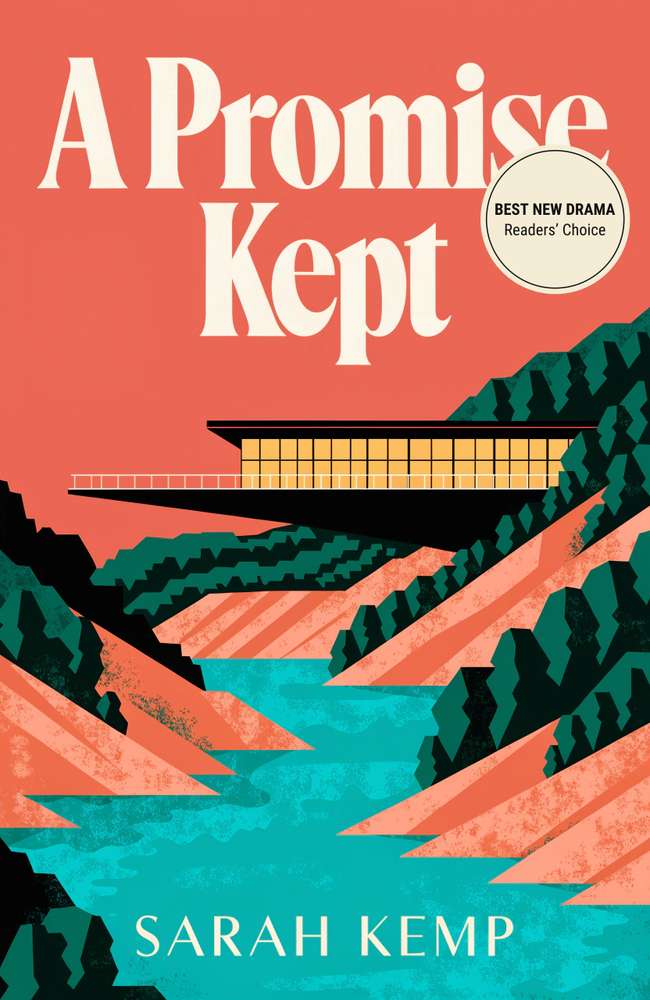
In the summer of 1957 my father, Leonard Fletcher, finished a house northeast of Cincinnati, on a wooded lot where a creek called Sycamore Run had cut a gorge through the limestone. At the top the gorge was about eighty feet wide. At the bottom, forty feet down, the water ran fast and brown in spring and slow and green in summer. Most men would have built on the flat ground beside it. My father built across it.
The house was a long glass box, a hundred and twelve feet from end to end, carried over the gorge on two steel trusses painted the dark gray of wet slate. There was one truss along each long side, beneath the floor, and they rested on concrete abutments set into the rock on either bank. When you stood inside and looked down through the glass, you saw treetops and water. When you looked up, you saw sky. There were no curtains. My father said curtains would be an insult to the view. My mother said nothing about it, but she bought my brother and me thick wool sleep masks, and I wore mine every summer morning until I was twelve.
The day we moved in, my brother Peter would not cross the threshold. He was four years old, small and fair, with a cowlick that no amount of water would flatten. He stood on the gravel at the east end, where the entry ran from the bank onto the bridge, and he looked down into the ravine and began to cry.
"Will it fall?" he asked.
My father laughed and swung him up onto his shoulders. My father was a big, handsome man with dark hair going silver at the sides, and he laughed easily, the way people do when they are used to being liked. "Not while I'm alive, sport," he said, and he carried Peter in.
My mother was behind me with a box of kitchen things in her arms. She set the box down on the gravel, crouched beside me, and spoke quietly so only I could hear.
"Not for a hundred years," she said. "Not if nobody does anything stupid to it."
That was the answer I believed. I want to be honest about that from the start. Even at nine, I believed her more than him.
My mother's name was Rose. She had been Rose Kemp before she married, from a family of schoolteachers in upstate New York, and she was not like the other mothers I knew. She was tall and thin, with brown hair she wore pinned up and then forgot about, so that by afternoon it was always coming down. She laughed at things other people did not notice were funny. She hummed when she cooked and swore when she burned things, and she burned things often, because she was usually thinking about something else. She was restless in a way I did not have a word for then. She could not sit through a church service without shifting in the pew. She walked fast. She read three newspapers a day and argued with all of them out loud.
And she loved that house. I knew it before I could have explained it. On our first night there she walked the full length of the long room in her stocking feet, from the kitchen at the east end to the bedrooms at the west, and she stopped at every steel mullion between the glass panels and touched it with two fingers, the way you might touch a child's forehead to check for fever. My father was out on the deck with a glass of bourbon, looking at the stars. He did not see her do it. I did.
That October, a national picture magazine called Panorama ran eight pages on the house. A photographer named Stuart Kline had spent three days with us in September, setting up lights and moving our furniture around and telling Peter to stop looking at the camera. The cover showed the house at dusk, lit from inside, floating over the dark ravine like a lantern. Inside there was my father on the deck in his shirtsleeves, one hand on the rail, looking out over the water as if he owned it. There was a picture of Peter and me lying on our stomachs on the living room floor, looking down through the glass at the creek. There was a picture of the kitchen, very clean, with a bowl of lemons on the counter that the photographer had brought himself. The headline said THE MAN WHO BUILT A BRIDGE TO LIVE ON.
My mother was not in any of the pictures. I noticed that, but only a little. I was nine and I was in a magazine, and that was the important thing.
After the magazine, everything changed for my father. He had grown up in Middletown, the son of a man who owned a lumberyard, and he had never gone to architecture school. He had learned building by building, first sheds and garages for his father's customers, then houses, then a small office in downtown Cincinnati with his name on the door. People had always liked him. Now they wanted him. The phone rang at dinner. Letters came from Chicago and New York and once from Sweden. A doctor in Indian Hill wanted a house. A college in Dayton wanted a library. A newspaper in Columbus called him "the most exciting architect Ohio has produced," and my father cut the article out and pinned it to the wall of his studio.
The studio was a low stone building on the east bank, joined to the house by the entry. It had a long workbench, flat files for drawings, two drafting tables, and a window that looked straight down the length of the house toward the far bank. One of the tables was my father's. The other, in the corner, was my mother's. I thought nothing of that. Lots of wives helped their husbands. My mother kept the books and answered letters and sometimes, my father said, "tidied up his lines."
What I remember best from those first years is not the magazine or the visitors. It is the kitchen table at night.
My mother did not sleep much. After Peter was in bed and my father was in the studio or out with a client, she would sit at the kitchen table with a cup of tea gone cold and her slide rule, and she would call me in.
"Lainey," she would say. "Come do a problem with me."
Other mothers taught their daughters gin rummy. Mine taught me loads.
"Here's a plank," she said the first time, drawing a line on the back of an envelope. "Twelve feet long. It's resting on two bricks, one at each end. Your brother climbs up and sits right in the middle. He weighs forty pounds. How much does each brick have to hold up?"
"Twenty pounds," I said.
"Good. Now he scoots over. He's sitting three feet from the left brick. Now what?"
I did not know. She showed me. She showed me how to think of the plank as a seesaw that wanted to turn, and how each brick pushed back just enough to keep it from turning. She showed me how to set the slide rule and read it, sliding the middle piece and moving the cursor with her thumb. Thirty pounds on the left, ten on the right. I worked it out myself the second time and she clapped her hands like I had done a magic trick.
After that we did a problem most nights. Planks became beams. Bricks became columns. Peter became a piano, then a car, then a snowfall of a certain depth over a certain roof. She never made it feel like school. She made it feel like a secret we shared, a game we were both good at. Sometimes, when I got a hard one right, she would sit back and look at me with an expression I did not understand until I had a daughter of my own. It was pride, but there was something under it, something that hurt.
Once, when the Panorama writer was still visiting, he had asked her what the house meant to her. I was sitting on the stairs to the deck, eating an apple, and I heard her answer.
"It's a promise kept," she said.
The writer smiled and wrote it down, but it did not appear in the magazine. Later that night, at the kitchen table, I asked her about it.
"Whose promise?"
She was quiet for a while, turning the slide rule over in her hands.
"Ask me again when you're older," she said.
I did ask again, more than once, over the years. She always found a way not to answer. In the end, she did not tell me. She showed me. But that was a long way off, and it would cost us nearly everything we had to get there.
On clear nights that first autumn, my mother and Peter and I would lie on our backs on the living room floor and look up through the glass. The sky over the house was as big as the floor, and the floor felt like it was floating. Peter would fall asleep there, and my mother would carry him to bed. I would stay and listen to the creek, which you could hear faintly even through the glass, and I would think that nothing could ever be wrong in a house like this. I was nine. I did not know yet that a house can be perfectly built and still not be safe.